
How to Choose the Right Fertilizer Granulation Plant for Your Raw Materials

When you plan a fertilizer production project, choosing the right granulation solution starts with understanding your raw materials. Different materials have different moisture levels, particle sizes, chemical properties, and granulation behaviors. A suitable production system can help you achieve stable operation and produce fertilizer products that match your target market.

Before selecting equipment, you can evaluate your materials, production capacity, and final product requirements. A professional supplier can help you compare different technologies and create a solution based on your actual situation.

Understand Your Raw Materials Before Selecting Equipment

Your raw materials influence the granulation process directly. Some materials have good compressibility and lower moisture, while others require additional preparation before granulation.

For example, organic materials may need fermentation, crushing, and screening before entering the granulation stage. Mineral or compound fertilizer materials may require precise mixing and moisture control to achieve consistent granules.

If you are planning a commercial fertilizer pellet production line, understanding your material characteristics helps you select equipment that matches your production goals.
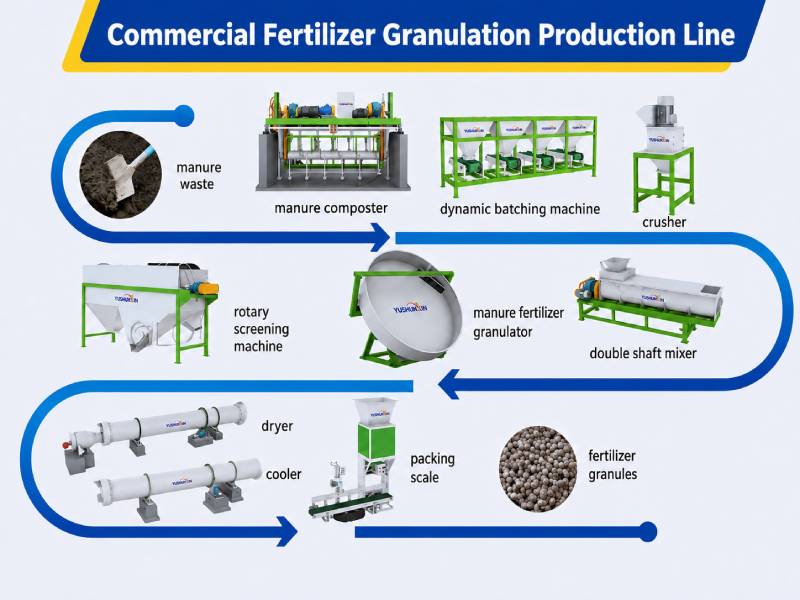
Commercial Fertilizer Granulation Production Line

Match Granulation Technology with Your Product Requirements

Different granulation technologies create different production advantages. Your choice may depend on the required particle size, granule appearance, production capacity, and energy consumption.

For projects requiring continuous production and stable output, a rotary drum granulator fertilizer production line can be considered as one possible solution. This type of system is commonly integrated with mixing, drying, cooling, screening, and coating processes to create a complete fertilizer production flow.

For materials with different characteristics, other granulation methods may also provide suitable options. Comparing equipment performance with your raw materials helps you avoid selecting a system based only on capacity numbers.

Consider Capacity and Investment Together

Production capacity is another important factor when choosing a fertilizer granulation plant. A small local fertilizer business and a large fertilizer manufacturer usually have different equipment requirements.

Many customers first ask how much does a fertilizer granulation plant cost, but the final investment depends on factors such as raw material preparation, production scale, automation level, and supporting equipment.

An industrial scale fertilizer granulation system may include automatic feeding, batching, granulation, drying, cooling, screening, packaging, and control systems. Reviewing the complete process helps you understand the relationship between investment and production efficiency.

Plan for Future Production Needs

When you design your fertilizer project, you can also consider future product expansion. If you plan to produce different fertilizer formulas or increase output later, a flexible equipment layout may provide more convenience.

Automation can also improve production management. A fertilizer granulation plant with automatic packaging connects granulation with the final packing stage, creating a smoother workflow from raw material processing to finished fertilizer bags.

Click here for more details to explore more fertilizer granulation solutions.

Choose a Solution Based on Your Project Goals

The right fertilizer granulation plant depends on the relationship between your raw materials, product requirements, production capacity, and investment plan. By evaluating these factors together, you can find a configuration that fits your business development.

For more information about fertilizer granulation solutions and equipment options, you can visit https://www.shunxin.eu/fertilizer-granulation-plant/
Annual output of 2000-10000 tons capacity organic fertilizer plant cost

Now more and more investors enter the organic fertilizer industry, but many users only have a simple understanding of the organic fertilizer industry and have no actual production. Therefore, there are still many problems in the investment process.

Pan Granulation Fertilizer Production Line

How much is the full set of organic fertilizer equipment? How to determine? In fact, customers will find a lot of opinions on how much, because each customer’s situation is different and there is no standard conclusion.

For example, the annual output and production process of customer a and customer B are basically the same, but customer a’s raw material is dry chicken manure and customer B’s raw material is wet chicken manure, so customer B must purchase a solid-liquid separator, but customer a does not.

Then the price difference will come out. Therefore, the input amount of organic fertilizer manufacturing process should be determined according to the actual situation.

A complete organic fertilizer production process includes machines: dumper, crusher, fertilizer granulator, dryer, screening machine and automatic packaging machine. These machines are usually necessary for a complete organic fertilizer production line.

In fact, these equipment have different types and specifications, such as fertilizer granulator, disc granulator, flat mold granulator and new organic fertilizer granulator, as well as other fertilizer equipment. Of course, the price of machines with different specifications is also different, so everything is subject to the actual production demand of customers.

Organic fertilizer equipment with an annual output of 2000-10000 tons
To sum up, how many complete sets of organic fertilizer equipment with an annual output of 2000 tons to 10000 tons? It depends on the manufacturing process of organic fertilizer.

Whether it’s NPK fertilizer manufacturing or livestock manure production projects of organic fertilizer, you are welcome to consult online or come to the factory to test the machine at any time. We welcome you at any time.

Role and deficiency of potassium fertilizer

Potassium is one of the three major elements of fertilizer. Potassium content in plants generally accounts for 0.2% ~ 4.1% of dry matter weight, second only to nitrogen. Potassium is involved in the activation of more than 60 enzyme systems, photosynthesis, assimilate transport, carbohydrate metabolism and protein synthesis during plant growth and development. In the fertilizer industry, potassium is often used as the main raw material and processed into special fertilizer products through NPK fertilizer granulator.

Main function of potassium fertilizer

1. Promote enzyme activation

Potassium fertilizer activating enzyme is one of the most important functions of potassium in plant growth. So. Potassium is closely related to many metabolic processes in plants, such as photosynthesis, respiration and the synthesis of carbohydrates, fats and proteins.

2. Promote photosynthesis and transport of photosynthetic products

It can improve photosynthetic efficiency, adjust stomatal opening and closing, and control the inflow and outflow of carbon monoxide and water. It can promote the synthesis of carbohydrates and accelerate the flow of photosynthetic products.

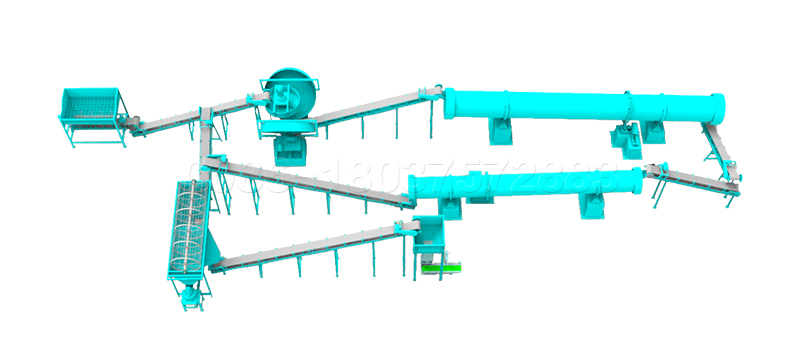
20t per hour drum granulation plant layout

3. Promote protein synthesis

No ₃ is a key component of protein synthesis, and its uptake and transport are closely related to the process of protein synthesis.

4. Enhance the stress resistance of plants

Potassium can reduce soluble amino acids and monosaccharides, increase cellulose and thicken cell wall; Potassium can produce osmotic pressure gradient in crop roots and enhance water absorption capacity; Potassium can close the stomata of crop leaves and prevent water loss during drought and water shortage. Therefore, potassium can enhance the disease resistance, cold resistance, drought resistance, lodging resistance and salt resistance of crops.

Harm of excessive application of potassium fertilizer

1. Excessive potassium application will not only waste valuable resources, but also reduce the absorption of cations such as calcium and magnesium by crops, resulting in “heart rot” of leafy vegetables and “bitter pox” of apples.

2. Excessive application of potassium fertilizer will cause soil environmental pollution and water pollution.

3. Excessive application of potassium fertilizer will weaken the production capacity of crops. Therefore, modern industry uses fertilizer production lines to mix NPK fertilizer in proportion. The proportion of each element in the formula is different according to different regions and fertilizer characteristics. The chemical fertilizer granulator makes different raw materials into granules to avoid the harm of chemical fertilizer raw materials.

Tips to make high nutrient organic fertilizer

Organic fertilizer has more nutrients and high content of organic matter. It can also loosen soil, improve soil fertility and improve soil structure. Organic fertilizer is favored by producers and producers to improve crop yield and quality. Since organic fertilizer is so good, do you know how to do it?

The main production process of organic fertilizer production line is to convert raw materials into semi-finished products. In the actual production process, the flat stack composting technology and tank aerobic fermentation process are mainly used.

In addition, the relevant experiments of organic fertilizer equipment can also be produced by small tank fermentation and closed box fermentation.
Process flow of organic fertilizer production line:

Raw material selection > drying and sterilization > fermentation > grinding > stirring > granulation > drying > cooling > coating > screening > metering and sealing > finished product warehousing.

Organic fertilizer production line

1. Tanker:

The can turnover machine is mainly used to help fermentation and decomposition proceed quickly. At the same time, oxygen can enter the reactor to avoid the smell produced by anaerobic reaction.

2. Forklift batching:

The blanking shall be uniform and continuous to avoid hindering the normal operation of the next equipment due to excessive materials.

3. High humidity material crusher:

During the composting process, the agglomerated materials are crushed evenly to reduce the diameter of the materials.

4. Drum screen:

The impurities and bulk materials not crushed are screened out to further improve the marketability.

5. Horizontal mixer:

If it is necessary to improve nutrient elements or produce standard organic fertilizer manufacturers, N, P, K, etc. need to be added.

6. Nitrogen, phosphorus and potassium fertilizer granulator:

Including various fertilizer granulation equipment, flat mold granulator, organic fertilizer granulator, disc granulator and drum granulator.

7. Drum drying cooler

8. Automatic packing scale:

After packaging, it is easy to store. At the same time, it will not cause dust pollution and waste during transportation.