
When you plan a fertilizer production project, choosing the right granulation solution starts with understanding your raw materials. Different materials have different moisture levels, particle sizes, chemical properties, and granulation behaviors. A suitable production system can help you achieve stable operation and produce fertilizer products that match your target market.
Before selecting equipment, you can evaluate your materials, production capacity, and final product requirements. A professional supplier can help you compare different technologies and create a solution based on your actual situation.
Understand Your Raw Materials Before Selecting Equipment
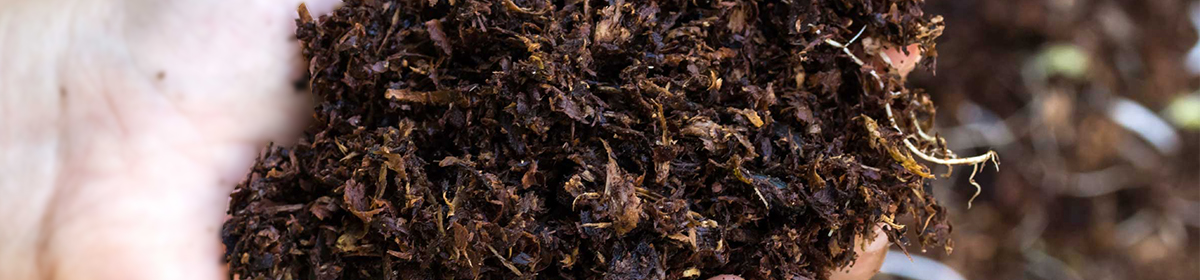
Your raw materials influence the granulation process directly. Some materials have good compressibility and lower moisture, while others require additional preparation before granulation.
For example, organic materials may need fermentation, crushing, and screening before entering the granulation stage. Mineral or compound fertilizer materials may require precise mixing and moisture control to achieve consistent granules.
If you are planning a commercial fertilizer pellet production line, understanding your material characteristics helps you select equipment that matches your production goals.
Match Granulation Technology with Your Product Requirements
Different granulation technologies create different production advantages. Your choice may depend on the required particle size, granule appearance, production capacity, and energy consumption.
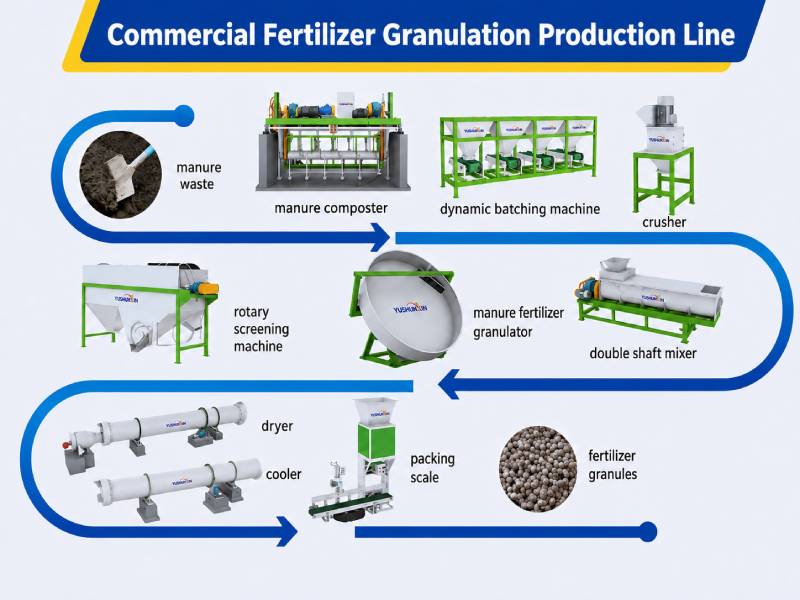
For projects requiring continuous production and stable output, a rotary drum granulator fertilizer production line can be considered as one possible solution. This type of system is commonly integrated with mixing, drying, cooling, screening, and coating processes to create a complete fertilizer production flow.
For materials with different characteristics, other granulation methods may also provide suitable options. Comparing equipment performance with your raw materials helps you avoid selecting a system based only on capacity numbers.
Consider Capacity and Investment Together
Production capacity is another important factor when choosing a fertilizer granulation plant. A small local fertilizer business and a large fertilizer manufacturer usually have different equipment requirements.
Many customers first ask how much does a fertilizer granulation plant cost, but the final investment depends on factors such as raw material preparation, production scale, automation level, and supporting equipment.
An industrial scale fertilizer granulation system may include automatic feeding, batching, granulation, drying, cooling, screening, packaging, and control systems. Reviewing the complete process helps you understand the relationship between investment and production efficiency.
Plan for Future Production Needs
When you design your fertilizer project, you can also consider future product expansion. If you plan to produce different fertilizer formulas or increase output later, a flexible equipment layout may provide more convenience.
Automation can also improve production management. A fertilizer granulation plant with automatic packaging connects granulation with the final packing stage, creating a smoother workflow from raw material processing to finished fertilizer bags.
Click here for more details to explore more fertilizer granulation solutions.
Choose a Solution Based on Your Project Goals
The right fertilizer granulation plant depends on the relationship between your raw materials, product requirements, production capacity, and investment plan. By evaluating these factors together, you can find a configuration that fits your business development.
For more information about fertilizer granulation solutions and equipment options, you can visit https://www.shunxin.eu/fertilizer-granulation-plant/